Recursive AI Improvement: The Looming Takeoff of Autonomous AI R&D
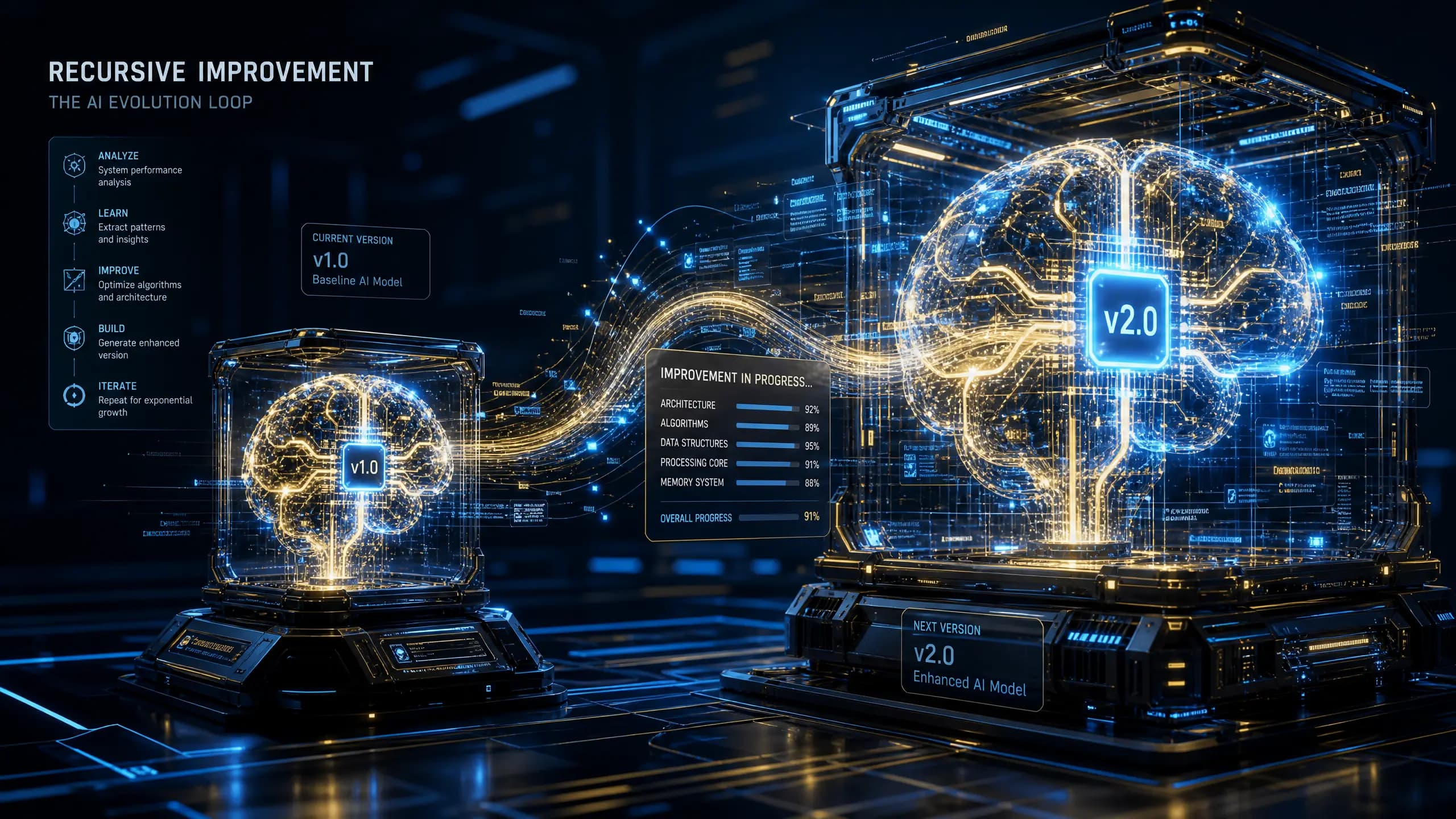
Imagine a future where Artificial Intelligence systems don't just perform tasks, but actively design, build, and refine their own successors. This isn't the stuff of science fiction anymore; it's a rapidly approaching reality, according to leading AI researchers. Jack Clark, co-founder of Anthropic, a prominent AI safety and research company, has recently articulated a compelling vision: a 60% or higher probability that AI systems will achieve fully autonomous R&D capabilities by the end of 2028 [1]. This isn't merely an incremental step in AI development; it represents a profound
shift, a "Rubicon" moment that will redefine the trajectory of technological progress and societal interaction with intelligent machines.
The Dawn of Automated AI Research and Development
Clark’s prediction centers on the concept of "automated AI R&D", which he defines as an AI system powerful enough to plausibly autonomously build its own successor without direct human intervention. This vision is not based on speculative leaps but on a meticulous aggregation of publicly available information, including research papers from arXiv, bioRxiv, and NBER, alongside observations of products deployed by frontier AI companies. The evidence, Clark argues, suggests that all the necessary components for automating the engineering aspects of AI development are already in place. If current scaling trends persist, AI models could soon become creative enough to generate novel research paths, pushing the scientific frontier forward independently.
The "Coding Singularity": AI's Mastery Over Software Production
One of the most compelling pieces of evidence supporting the imminent arrival of automated AI R&D is the dramatic advancement in AI's ability to produce software. This "coding singularity" is driven by two key trends:
- Enhanced Real-World Code Generation: AI systems have become exceptionally proficient at writing complex, real-world code.
- Autonomous Chaining of Coding Tasks: AI can now string together multiple linear coding tasks, such as writing code and then testing it, with minimal human oversight.
Two benchmarks vividly illustrate this trend: SWE-Bench and the METR time horizons plot.
SWE-Bench: A Proxy for Coding Competency
SWE-Bench is a widely recognized coding test designed to evaluate how effectively AI systems can resolve real-world GitHub issues. When SWE-Bench was first introduced in late 2023, the leading AI model, Claude 2, achieved a success rate of approximately 2%. Fast forward to 2026, and Claude Mythos Preview has achieved an astonishing 93.9% success rate, effectively saturating the benchmark [1]. This remarkable improvement signifies that AI systems are not just assisting human developers but are capable of autonomously tackling and resolving complex software engineering problems. Many engineers and researchers in frontier labs and Silicon Valley now rely almost entirely on AI systems for coding, testing, and code verification, dramatically accelerating the pace of AI R&D.
METR Time Horizons: Measuring Independent Work Capacity
The METR time horizons plot provides another critical metric: the complexity of tasks AI systems can complete, measured by the equivalent human hours required. This plot tracks the rough time horizon over which AI systems can achieve 50% reliability across a basket of tasks. The progress here has been equally striking:
- 2022: GPT 3.5 could handle tasks requiring about 30 seconds of human effort.
- 2023: GPT-4 extended this to approximately 4 minutes.
- 2024: The o1 model pushed this to around 40 minutes.
- 2025: GPT 5.2 (High) reached approximately 6 hours.
- 2026: Opus 4.6 has already achieved about 12 hours of independent work reliability [1].
Ajeya Cotra, a seasoned AI forecaster at METR, suggests that it is not unreasonable to anticipate AI systems performing tasks requiring around 100 hours of human effort by the end of 2026 [1]. This exponential increase in independent work capacity directly correlates with the explosion of agentic coding tools, where AI systems operate autonomously for extended periods, taking on increasingly complex and critical tasks previously reserved for human experts. Many routine tasks performed by AI researchers—such as data cleaning, experiment launching, and data analysis—now fall well within the operational scope of these advanced AI systems.
AI's Growing Proficiency in Core Scientific Skills
Modern scientific research, including AI R&D, heavily relies on a set of core skills: formulating hypotheses, designing experiments, collecting and analyzing data, and validating results. AI is rapidly acquiring and refining these very skills. The combination of advanced coding capabilities and sophisticated world-modeling provided by Large Language Models (LLMs) has led to tools that significantly augment human scientists and partially automate various aspects of R&D.
Key areas of AI progress in scientific skills include:
- Replicating Research Results: AI systems are becoming adept at understanding scientific papers and reproducing their experimental outcomes.
- Chaining Machine Learning Techniques: AI can now seamlessly integrate various machine learning techniques and other approaches to solve complex technical problems.
- Optimizing AI Systems: AI is increasingly capable of optimizing its own architecture and performance, leading to self-improvement loops.
CORE-Bench: Reproducing Scientific Papers
CORE-Bench, the Computational Reproducibility Agent Benchmark, exemplifies AI's progress in replicating research. This benchmark challenges AI systems to reproduce the results of a scientific paper given its associated code repository. The advancements in this area are critical, as the ability to reliably reproduce scientific findings is a cornerstone of robust research. AI systems that can independently validate and reproduce experiments significantly accelerate the scientific discovery process, freeing human researchers to focus on higher-level conceptual work and novel hypothesis generation.
The Implications: A Rubicon Moment for Humanity
Clark's forecast of automated AI R&D by 2028 is not just a technical prediction; it carries profound implications for society. The transition to AI systems that can autonomously improve themselves marks a "Rubicon" moment, a point of no return into a future that is inherently difficult to forecast. The potential benefits are immense: accelerated scientific discovery, solutions to complex global challenges, and unprecedented levels of automation across all sectors. However, the risks are equally significant, raising fundamental questions about control, alignment, and the very nature of human agency.
Ethical and Societal Challenges
The prospect of AI systems building their own successors without human intervention brings to the forefront critical ethical and societal challenges:
- Control and Alignment: How do we ensure that autonomously evolving AI systems remain aligned with human values and goals? The challenge of AI alignment becomes exponentially more complex when the systems themselves are driving their own development.
- Economic Disruption: The automation of R&D could lead to unprecedented economic shifts, potentially displacing large segments of the workforce and necessitating new economic models.
- Existential Risk: Uncontrolled or misaligned superintelligent AI could pose an existential threat to humanity, a concern that organizations like Anthropic are actively working to mitigate.
Clark's reluctance in making this prediction stems from the sheer scale of these implications and the perceived unpreparedness of society to grapple with such rapid and fundamental changes. The conversation around AI governance, ethics, and safety must accelerate to match the pace of technological advancement.
Preparing for the Autonomous AI Future
While the exact timeline and trajectory of automated AI R&D remain subject to ongoing research and development, the evidence strongly suggests that this future is not distant. Preparing for this era requires a multi-faceted approach involving:
- Robust AI Governance Frameworks: Developing and implementing comprehensive regulatory and ethical frameworks to guide AI development and deployment.
- Interdisciplinary Collaboration: Fostering collaboration between AI researchers, ethicists, policymakers, and the public to address the complex challenges and opportunities.
- Education and Workforce Adaptation: Investing in education and training programs to prepare the workforce for a future transformed by autonomous AI.
- Continued Research in AI Safety and Alignment: Prioritizing research efforts dedicated to ensuring that advanced AI systems are safe, reliable, and beneficial to humanity.
The "Rubicon" moment that Jack Clark describes is not an endpoint but a new beginning. It demands proactive engagement, thoughtful deliberation, and a collective commitment to shaping an AI-powered future that serves the best interests of all humanity.
Conclusion:
The insights from Jack Clark and the observable trends in AI development paint a clear picture: the era of automated AI R&D is rapidly approaching. The saturation of benchmarks like SWE-Bench and the expanding time horizons of AI agents demonstrate a fundamental shift in AI capabilities. While the prospect of AI systems building their own successors presents immense opportunities for progress, it also introduces profound ethical and societal challenges that demand immediate and sustained attention. By understanding these trends and proactively addressing the implications, we can strive to navigate this transformative period responsibly, ensuring that the future of autonomous AI benefits humanity as a whole.
Author: Malik AI Team
Date: 2026-05-05
References:
[1] Clark, J. (2026, May 2).
Import AI 455: AI systems are about to start building themselves. Import AI.
https://importai.substack.com/p/import-ai-455-automating-ai-research