Every business accumulates knowledge it cannot efficiently use. Product documentation that customer support cannot quickly search. Past project files that new team members have to rediscover from scratch. Policy documents that require ten minutes of navigation to find a single rule. Sales call notes that contain patterns nobody has time to analyze. Internal knowledge locked in human memory that leaves when people leave.
RAG — Retrieval-Augmented Generation — is the architecture that unlocks this knowledge. It allows a business to connect an AI language model to its own documents, databases, and content so that the AI answers questions using the actual information the business has, rather than general training data that does not know your specific pricing, your specific policies, or your specific customer history.
In 2026, RAG has moved from cutting-edge AI research to accessible business infrastructure. The tools required to build a production-grade RAG pipeline are available to any organization with a developer or a technical operator — and in some cases, without even that.
This guide explains what RAG is in plain language, why it matters for business, how it works technically (without requiring you to understand the mathematics), what tools to use, and how to implement one step by step.
What RAG Actually Is — The Plain Language Explanation
Imagine you hire a brilliant research assistant with encyclopedic general knowledge but no specific knowledge of your company. Every time you ask them something specific — "what does our enterprise license cover?" or "what was the outcome of the Taylor account negotiation?" — they cannot answer because that knowledge is not in their head.
Now imagine that same assistant with access to a search system connected to all your documents: your product documentation, your CRM notes, your internal policies, your past projects. When you ask them a question, they first search the documents for the most relevant passages, read them, and then answer you — using the actual information from your documents rather than guessing.
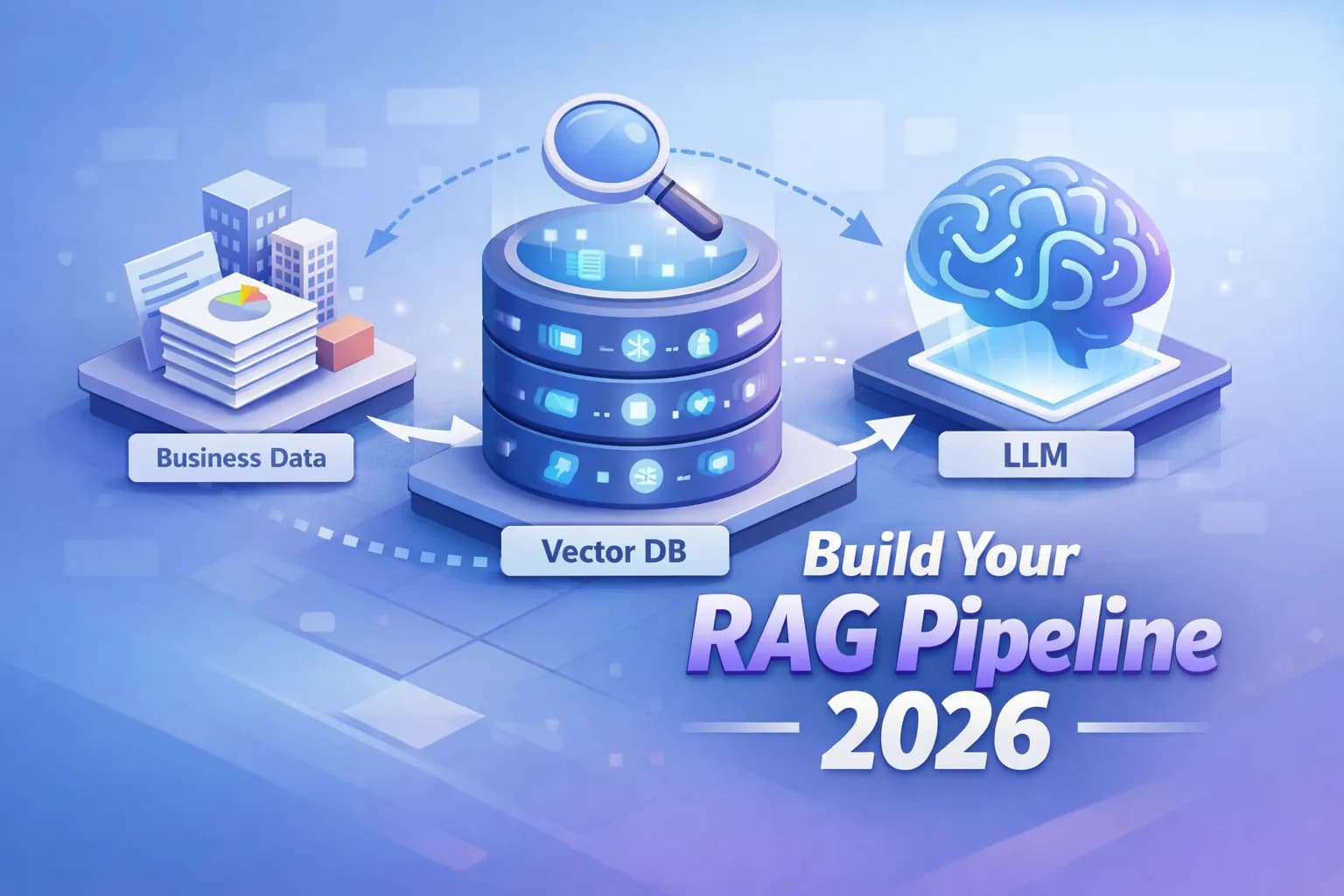
That is RAG. The AI language model is the brilliant research assistant. The vector database is the search system. The retrieval step is the document search. The generation step is the AI formulating an answer based on what it found.
The key difference from a regular AI chatbot: a standard chatbot answers from its training data — which knows nothing about your business. A RAG-powered chatbot answers from your documents — which know everything about your business that you have written down.
Why Businesses Need RAG in 2026
The business case for RAG is straightforward and measurable.
Customer support efficiency: A manufacturing company documented a 65% reduction in order processing time after implementing a RAG system over their supplier documentation and order history. Customer-facing support staff could find answers to complex product questions in seconds rather than minutes of documentation search.
Employee productivity: A professional services firm with 40 employees that implemented a RAG system over 800+ documents (HR policies, product specifications, quality procedures, supplier contracts, client correspondence) found that new employee onboarding time reduced from 3 weeks to 12 days. Senior staff time spent answering internal questions dropped by an estimated 8 hours per week.
Sales acceleration: RAG systems that give salespeople instant access to product specifications, pricing history, and previous client communications reduce proposal preparation time and improve response accuracy in client meetings.
Knowledge preservation: When senior employees leave, their knowledge goes with them. RAG systems built over documented processes, past project records, and decision rationale preserve institutional knowledge in an accessible, searchable form.
The technology enabling all of this has become dramatically more accessible in 2026. Vector database hosting costs have dropped significantly. Embedding model quality has improved substantially. Orchestration frameworks including LangChain and n8n's AI agent nodes have made building RAG pipelines achievable without specialized machine learning expertise.
How RAG Works: The Technical Reality Without the Math
Understanding the mechanism helps you make better implementation decisions.
Step 1: Document ingestion
Your source documents — PDFs, Word files, Google Docs, web pages, database exports, CRM notes — are processed and converted into a format the retrieval system can search. This involves:
Parsing each document to extract its text content. Images in PDFs may require OCR (optical character recognition) to convert to text. Splitting long documents into smaller chunks (typically 200 to 800 words each) that the retrieval system can retrieve independently. Each chunk preserves information about where it came from (which document, which page, which section) so the source can be cited in responses.
Step 2: Embedding generation
Each chunk of text is converted into a vector embedding — a list of numbers that represents the semantic meaning of the text. Two chunks that discuss related topics will have similar embeddings (similar numbers) even if they use different words. This is what allows semantic search rather than keyword matching.
The embedding conversion uses an embedding model. OpenAI's
text-embedding-3-small
is the most commonly used commercial option. Open-source alternatives including Sentence-Transformers run locally for organizations with data privacy requirements.
Step 3: Vector database storage
The embeddings (and the original text they represent) are stored in a vector database. When you search for relevant passages, the vector database compares the embedding of your question against all stored embeddings and returns the passages with the closest semantic match.
The most commonly used vector databases in 2026:
- Pinecone — managed cloud service, no infrastructure management
- Qdrant — open source, self-hostable, excellent for data sovereignty requirements
- Weaviate — open source with cloud option, good for mixed structured and unstructured data
- pgvector — extension for PostgreSQL, ideal if you already use PostgreSQL
Step 4: Query processing and retrieval
When a user asks a question, the question is converted to an embedding using the same embedding model used for the documents. The vector database finds the document chunks with embeddings closest to the question's embedding — typically the top three to five most relevant chunks.
Step 5: Prompt construction and generation
The retrieved chunks are included in the prompt sent to the language model, along with the original question and instructions on how to answer. The prompt tells the model: here is the relevant information from our documents, please answer this question based on that information.
The language model generates a response grounded in the retrieved information — not from its general training data, but from your specific documents.
Step 6: Response and citation
The final response is delivered to the user, ideally with citations pointing to the specific documents or pages the answer came from. This allows users to verify the answer by reading the source and builds trust in the system's accuracy.
The Tools Available in 2026
Orchestration Frameworks
LangChain is the most widely adopted RAG orchestration framework, available in both Python and JavaScript. It provides modular components for each step of the RAG pipeline — document loading, text splitting, embedding, vector storage, retrieval, and generation — that can be assembled in various configurations.
LlamaIndex is the primary alternative to LangChain, with a stronger focus on data indexing and querying. Many practitioners prefer LlamaIndex for complex RAG implementations involving multiple document types or query strategies.
n8n AI agent nodes allow non-developers to build basic RAG pipelines through a visual interface. For organizations without Python developers, n8n's combination of document processing, HTTP request nodes (for embedding API calls), and AI agent nodes provides a buildable entry point without writing code.
Embedding Models
OpenAI text-embedding-3-small — $0.02 per million tokens, excellent quality, the default choice for most implementations. API-dependent, meaning document content passes through OpenAI's servers.
OpenAI text-embedding-3-large — higher quality at higher cost. Worth it for precision-critical applications.
Sentence-Transformers — open source, runs locally, free after compute costs. Best option for organizations with strict data privacy requirements where document content cannot leave internal infrastructure.
Language Models for Generation
OpenAI GPT-4o — the most commonly used generation model for production RAG. Strong instruction following, accurate source attribution, and excellent performance on question-answering tasks.
Anthropic Claude 3.5 Sonnet — strong alternative with particularly good performance on documents requiring nuanced interpretation and on tasks where acknowledging uncertainty is important.
Meta Llama 3 — open source, self-hostable, no API cost after compute. Strong option for organizations with high query volumes where API costs would be significant.
Vector Databases
Qdrant — the recommended choice for self-hosted implementations. Well-documented, resource-efficient, and free. Runs on a standard VPS server.
Pinecone — the recommended choice for managed cloud implementations. No infrastructure management, predictable pricing, and good developer experience.
Supabase with pgvector — if you already use Supabase for your database, adding vector storage through pgvector avoids managing a separate database system.
Building Your First RAG Pipeline: Step by Step
Phase 1: Define the knowledge domain (Week 1)
Before touching any technology, define what the system should know and what questions it should answer. A knowledge domain that is too broad produces lower retrieval precision than one focused on a specific domain.
Start narrow. A customer support RAG system built over product documentation performs better than one built over all company documents simultaneously. Expand the scope after validating the narrow implementation.
Document the 20 to 30 most common questions the system should answer. These become your test set for evaluating whether the implementation works.
Phase 2: Prepare your documents (Week 1 to 2)
Document quality directly determines RAG output quality. Before ingesting documents:
Remove duplicates and outdated versions. Ensure all documents are text-extractable (scanned PDFs require OCR processing through tools like
Adobe PDF services or
AWS Textract). Add metadata to documents (type, date, author, topic) — this metadata is stored alongside embeddings and allows filtering retrieval by document type. Split very long documents at natural logical boundaries (chapters, sections) before ingesting — this improves chunking quality.
Phase 3: Set up the vector database (Week 2)
For a self-hosted implementation: install Qdrant on a VPS (DigitalOcean or Contabo, $10 to $20/month), configure an SSL certificate, and create a collection for your document embeddings.
For a managed implementation: create a Pinecone account, set up an index with the correct dimensions for your chosen embedding model (1536 for OpenAI text-embedding-3-small), and note the API key.
Phase 4: Build the ingestion pipeline (Week 2 to 3)
The ingestion pipeline processes your documents and loads them into the vector database. Using LangChain in Python:
The pipeline reads each document, splits it into chunks, generates embeddings for each chunk using the embedding model API, and stores the embeddings plus the original text plus the metadata in the vector database. This runs once for the initial document set and then whenever new documents are added or existing documents are updated.
For n8n-based implementations without Python: use HTTP Request nodes to call the OpenAI embeddings API for each document chunk, then use additional HTTP Request nodes to write the embeddings to Qdrant's REST API. This is more manual than LangChain but achievable without writing code.
Phase 5: Build the query and generation pipeline (Week 3)
The query pipeline handles each user question: convert the question to an embedding, retrieve the most relevant document chunks from the vector database, construct the prompt with the retrieved context, send to the language model, and return the answer with citations.
The system prompt for the language model must explicitly instruct it to:
- Answer only from the provided context documents
- Say clearly when the context does not contain sufficient information to answer the question
- Cite the specific documents that the answer draws from
- Not use general knowledge to supplement when context is insufficient
This last point — explicitly prohibiting the model from using general knowledge to fill gaps — is the most critical quality safeguard. Without it, the model will confidently fabricate answers that sound plausible but are not from your documents.
Phase 6: Test with your question set (Week 3 to 4)
Run every question from your test set through the system. Evaluate each answer on:
- Accuracy — is the answer factually correct based on the source documents?
- Completeness — does the answer cover all relevant information from the documents?
- Appropriate uncertainty — when documents do not contain sufficient information, does the system acknowledge this rather than guessing?
- Citation quality — does the system cite the correct source documents?
Answers that fail accuracy or appropriate uncertainty tests typically indicate problems with the chunking strategy, the prompt instructions, or the retrieved context quality. Fix each category of failure at its source before expanding the knowledge domain.
Cost Estimates for a Business RAG System
Using OpenAI embeddings and GPT-4o generation:
- Embedding cost for 1,000 pages of documents: approximately $0.04 (essentially free for initial ingestion)
- Query cost at 500 queries per month with retrieved context of 2,000 tokens: approximately $15 to $25 per month
- Vector database hosting (Qdrant on $10/month VPS): $10/month
Total monthly operational cost for a 500-query-per-month RAG system: approximately $25 to $35 (7,000 to 9,800 PKR). For a 5,000-query-per-month system: approximately $150 to $200 (42,000 to 56,000 PKR).
Frequently Asked Questions
Does building a RAG pipeline require machine learning expertise?
Not in 2026. LangChain and LlamaIndex provide high-level Python APIs that abstract the underlying machine learning operations. A developer with Python familiarity can implement a working RAG pipeline in one to three days using these frameworks. For non-developers, n8n's visual interface provides a buildable entry point for simpler implementations, though production-grade RAG typically benefits from developer involvement.
How much historical data does RAG require to work?
RAG works with any amount of documentation. A single 50-page policy document produces useful results. The quality of answers scales with the quality and coverage of the documents — more comprehensive documentation produces more comprehensive answers, but the system works at any scale.
How does RAG handle Urdu documents?
RAG works with Urdu documents using multilingual embedding models (multilingual-e5 or mBERT). OpenAI's embedding models handle Urdu with reasonable quality, though performance may be somewhat lower than for English documents. For production Urdu RAG, test retrieval precision with Urdu test queries before deploying.
What prevents the AI from making up answers?
The system prompt explicitly instructs the model to answer only from the provided context and to acknowledge when it cannot find an answer. Testing the system against questions outside its knowledge base — and confirming it declines appropriately — is a critical validation step before deployment. No instruction can completely prevent hallucination in all cases, which is why human review of high-stakes answers is recommended.
RAG is not a future capability — it is table stakes for any business that wants to unlock the knowledge locked in its documents and provide employees or customers with instant, accurate access to that knowledge. The tools are mature, the costs are accessible, and the business value is documented across multiple industries. The question in 2026 is not whether to build a RAG system but which business problem to solve with it first.
References: