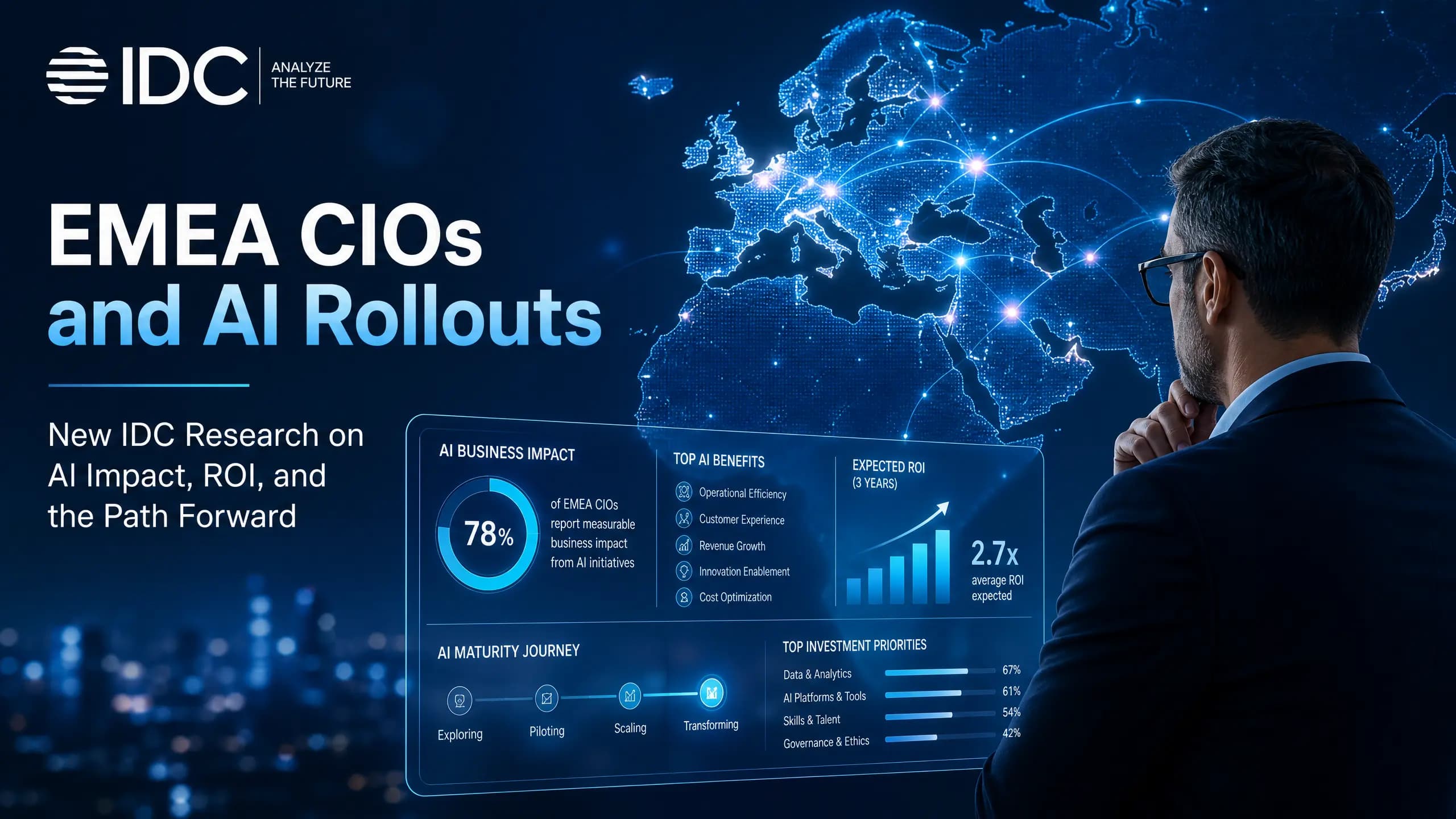
IDC EMEA CIOs AI Rollouts: Strategies for Accelerating Impact
In the dynamic landscape of enterprise technology, Artificial Intelligence (AI) has emerged as a transformative force, promising unprecedented operational efficiencies and innovative revenue streams. However, despite significant investments and widespread adoption, many organizations in the EMEA (Europe, Middle East, and Africa) region find their AI initiatives stalled. According to IDC research, a substantial majority of AI projects fail to deliver quantifiable business outcomes, often remaining trapped in perpetual pilot phases. This article delves into the critical insights from IDC, outlining how EMEA CIOs can effectively jumpstart their AI rollouts, overcome common hurdles, and ensure their AI investments translate into tangible, long-term value.
The AI Paradox: High Investment, Low Return
Over the past 18 months, AI deployments across Europe have surged, with companies pouring capital into large language models and machine learning technologies. The expectation has been clear: heavy operational upgrades and significant competitive advantages. Yet, IDC’s findings paint a sobering picture: boards are increasingly slowing down, scaling back, or even refocusing these initiatives. The primary drivers for this contraction are not a lack of technical interest, but rather persistent execution issues and a struggle to demonstrate clear financial validation.
Key Statistics:
- Only 9% of organizations in the EMEA region have managed to deliver quantifiable business outcomes from most of their AI projects over the past two years.
- A staggering 91% remain stuck, often marooned in the pilot phase without achieving broader organizational impact.
This
paradox highlights a critical challenge: while AI’s potential is widely recognized, its practical implementation and value realization remain elusive for many. Competing IT demands, coupled with macroeconomic pressures, are forcing directors to demand hard evidence of financial returns before authorizing wider deployment. Projects rarely suffer catastrophic technical failure; instead, they bleed momentum, failing to transition from promising experiments to integral business functions.
Moving Beyond Traditional Procurement Metrics: Redefining ROI
One of the most significant barriers to successful AI rollout is the reliance on traditional procurement metrics. Historically, software licensing costs were directly mapped against human headcount reduction, a straightforward calculation of value. However, the value proposition of generative models and intelligent routing systems is far more nuanced, materializing through indirect avenues such as enabling new revenue streams, accelerating worker output, and lowering corporate risk.
Consider a predictive maintenance tool in a manufacturing plant. This AI might not directly reduce the engineering team’s size. Instead, its true value lies in preventing a massive assembly line failure, which could cost millions in downtime and repairs. The financial benefit of such an avoided disaster does not typically appear on a standard departmental spreadsheet, making it challenging to quantify using conventional ROI models. This disconnect often leads to promising pilots losing funding before they can reach production networks.
Technology chiefs must actively rewrite their ROI calculations to capture these expansive, indirect benefits, mapping them directly to the company’s bottom line. This requires a shift in mindset from cost-cutting to value creation, recognizing that AI’s impact often extends beyond immediate, easily quantifiable metrics. Without a defined financial framework that accounts for these broader benefits, AI initiatives will continue to struggle for sustained investment.
The Challenge of Scaling from Pilot to Production
Expanding an AI pilot into a permanent corporate function demands intense, sustained capital. While innovation budgets can easily cover initial API calls and cloud testing environments, pushing a model into a live environment requires continuous investment in robust infrastructure, active data pipelines, and daily maintenance. This transition often exposes significant architectural gaps, particularly when moving from a flexible AWS or Azure sandbox to a full corporate deployment.
Engineering units frequently encounter friction when attempting to integrate modern vector databases with decades-old, on-premise Oracle or SAP servers. A Retrieval-Augmented Generation (RAG) architecture, for instance, necessitates clean and categorized information. Attempting to run large language models on disorganized storage inevitably leads to low-quality outputs and high hallucination rates, undermining the very purpose of the AI.
Rectifying these structural deficiencies requires extensive and often expensive data restructuring before the AI software can function properly. Furthermore, the continuous compute costs associated with inference generation and model tuning climb aggressively, forcing technology chiefs to justify their hyperscaler bills to increasingly skeptical finance teams. This financial scrutiny underscores the need for a clear, well-articulated business case that demonstrates long-term value.
Navigating Regulatory Complexities: Compliance as an Accelerant
Regional laws governing data protection and cybersecurity significantly influence AI deployment parameters across Europe. Securing internal networks against prompt injection attacks and meticulously documenting model decision trees elevate baseline operational costs. Many deployment teams perceive these legal requirements as heavy restrictions, hindering innovation and increasing complexity.
However, successful organizations adopt a different perspective, viewing compliance rules as an accelerant for better system architecture. By building governance structures from day one, they actively streamline the scaling process. This proactive approach ensures that AI systems are designed with security, privacy, and ethical considerations embedded from the outset, rather than being retrofitted later.
Companies that embrace this rigorous compliance work report several benefits:
- Improved corporate resilience: Robust governance frameworks enhance an organization’s ability to withstand cyber threats and data breaches.
- Better ESG performance: Adherence to ethical AI principles contributes to stronger Environmental, Social, and Governance (ESG) credentials.
- Deeper trust from customers: Transparency and responsible AI practices foster greater customer confidence.
In this context, legislation acts not as a barrier but as a catalyst for trusted deployment, compelling engineering teams to establish essential data controls regardless of government mandates. This strategic alignment of compliance and development ultimately leads to more robust, reliable, and scalable AI solutions.
Designing for Real Workflows: The Human Element in AI Adoption
One of the heaviest resistances to AI adoption often occurs at the desk level. Technology chiefs frequently design sophisticated software solutions that employees are reluctant to use. This algorithmic adaptation represents an organizational barrier, not purely a technical one. Overcoming resistance to process change requires aligning the technology directly with existing workforce capabilities and corporate culture.
Engineering directors must invest in reskilling programs and active change management initiatives to secure trust in machine-driven processes. Failing to address the human element practically guarantees slower adoption and restricted operational reach. Software integrations succeed when they genuinely remove friction from an employee’s daily routine, making their work easier and more efficient.
The companies that extract long-term value from AI intentionally design their deployments around human workflows, ensuring the end-user actively benefits from the new tools. For example, an automated contract review system should empower corporate counsel to focus on high-value negotiations rather than mundane compliance checking. This approach transforms AI from a potential threat to job security into a valuable co-pilot, enhancing human capabilities.
The CIO as a Driver of Digital and AI Transformation
AI now sits at the center of corporate operations, and modern digital leaders must actively drive growth and engineer systems that post positive returns. According to IDC, 42% of EMEA C-Suite leaders expect their CIO role to lead digital and AI transformation, with a major focus on specifically creating new revenue streams. This elevated expectation demands an aggressively commercial mindset from CIOs.
The days of the technology leader functioning purely as a procurement officer and network maintainer are over. CIOs must now connect experimental initiatives directly to tangible business outcomes, enforcing absolute alignment across all departments. This requires a deep understanding of both technology and business strategy, enabling them to articulate AI’s value in terms that resonate with the entire executive board.
Success in the current market relies heavily on execution. Organizations that are successfully breaking out of the pilot phase are those that link their engineering work to commercial objectives, embed governance early in the development cycle, and meticulously match their software solutions to human adaptation. As the market transitions, the ability to measure financial returns accurately and build robust enterprise scaling frameworks will determine which companies capture actual value from their AI investments. Technology leaders must proactively adapt their operating models to support these evolving AI systems, ensuring they are not just adopters but true innovators.
Conclusion: Charting a Course for AI Success in EMEA
For EMEA CIOs, the path to successful AI rollouts is clear: it requires a strategic shift from isolated experimentation to integrated, governed, and human-centric deployment. By aggressively auditing existing systems, redefining ROI metrics to capture indirect value, embracing compliance as a strategic advantage, and designing AI solutions that augment human workflows, organizations can unlock the full potential of their AI investments. The future of AI in EMEA is not just about technological advancement; it’s about strategic leadership that transforms AI into a powerful engine for sustainable growth and competitive advantage. The time for CIOs to jumpstart their AI rollouts and drive measurable impact is now.