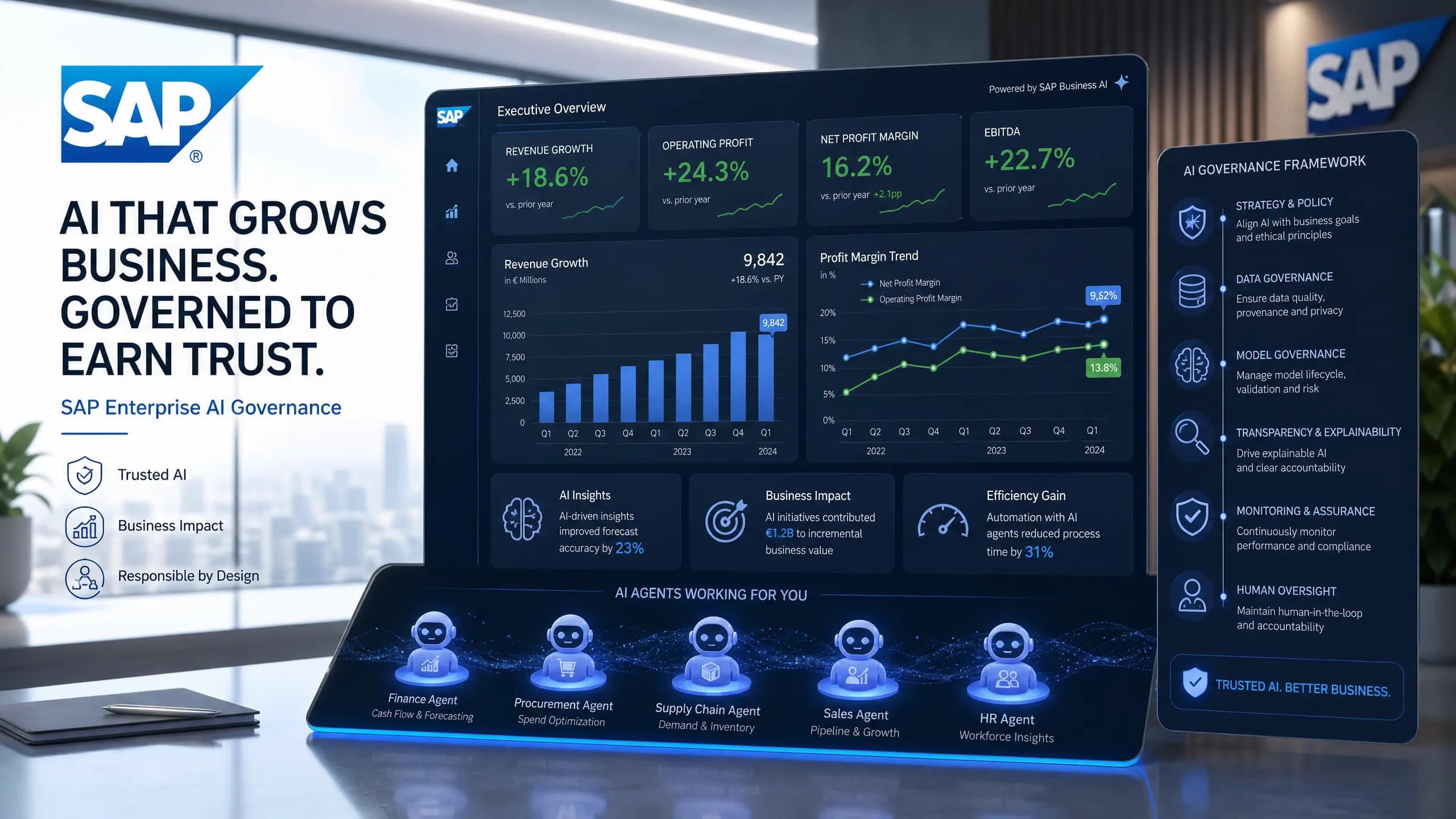
SAP Enterprise AI Governance: Securing Profit Margins in the AI Era
In today's rapidly evolving digital landscape, artificial intelligence (AI) is no longer a futuristic concept but a fundamental driver of business transformation. However, the true value of AI in the enterprise is unlocked not just by adoption, but by robust AI governance. According to SAP, effective enterprise AI governance is the key to securing profit margins, transforming statistical guesses into deterministic control, and ensuring AI initiatives deliver tangible business impact.
The Imperative of Precision: Why 100% Accuracy Matters
Manos Raptopoulos, Global President of Customer Success Europe, APAC, Middle East & Africa at SAP, starkly articulates the critical need for precision in enterprise AI: "The distance between 90% and 100% accuracy is not incremental. In our world, it is existential." This statement underscores a fundamental truth for businesses deploying AI: while consumer-grade models might tolerate minor inaccuracies, enterprise applications demand absolute reliability. A small error in a financial forecast or a supply chain optimization can have catastrophic consequences, impacting revenue, customer trust, and regulatory compliance.
As organizations increasingly integrate large language models (LLMs) and other AI systems into their production environments, the evaluation criteria have shifted. The focus is now firmly on precision, governance, scalability, and demonstrable business impact. This transition highlights a maturation in how enterprises view and implement AI, moving beyond experimental phases to demanding concrete, measurable returns.
Real-World Example: Supply Chain Optimization
Consider a global manufacturing company utilizing AI for supply chain optimization. A 90% accurate AI might predict demand with reasonable success, but the remaining 10% inaccuracy could lead to significant overstocking or understocking. Overstocking ties up capital and incurs storage costs, while understocking results in lost sales and customer dissatisfaction. With a 100% accurate, well-governed AI, the company can achieve just-in-time inventory management, reducing costs by millions and improving customer fulfillment rates. This deterministic control, rather than probabilistic estimation, directly translates into secured profit margins.
The Rise of Agentic AI and the Governance Challenge
The advent of agentic AI systems marks a new frontier in enterprise AI. These systems possess the advanced capabilities to plan, reason, orchestrate with other agents, and execute complex workflows autonomously. While this autonomy offers unprecedented efficiency and innovation, it also introduces significant governance challenges. As Raptopoulos warns, treating these autonomous digital actors with anything less than the rigorous governance applied to human workforces exposes organizations to severe operational risks. The potential for "agent sprawl"—uncontrolled proliferation of AI agents—could mirror the shadow IT crises of the past, but with far higher stakes given AI's direct interaction with sensitive data and influence on critical decisions.
Effective governance for agentic AI necessitates a comprehensive framework that includes:
- Agent lifecycle management: From development and deployment to monitoring and retirement.
- Defining autonomy boundaries: Clearly delineating what an agent can and cannot do.
- Enforcing policy: Ensuring AI actions align with corporate policies and regulatory requirements.
- Continuous performance monitoring: Regularly assessing agent behavior and outcomes.
These requirements are not merely compliance checkboxes; they are foundational to mitigating risks such as data breaches, biased decision-making, and operational disruptions. The financial implications of neglecting these aspects can be substantial, ranging from regulatory fines to reputational damage and direct financial losses.
Structuring Relational Intelligence for Commercial Operations
At the heart of effective enterprise AI lies the data foundation. AI systems are only as good as the data they process. Fragmented master data, siloed business systems, and overly customized Enterprise Resource Planning (ERP) environments introduce dangerous unpredictability. If an autonomous agent makes recommendations based on unreliable data, the operational damage—affecting cash flow, customer relations, or compliance—can scale instantly.
True enterprise intelligence, as advocated by Raptopoulos, must transcend generic large language models trained on internet-scale text. It must be grounded in proprietary corporate data, including orders, invoices, supply chain records, and financial postings, all embedded directly into business processes. This approach leverages relational foundation models optimized for structured business data, which consistently outperform generic models in critical areas like forecasting, anomaly detection, and operational optimization.
Industry Insight: The Cost of Data Ingestion Failures
Data engineering teams often spend excessive time and resources sanitizing fragmented master data to create a baseline for AI ingestion. This operational friction can significantly delay deployments and inflate costs. When a relational model needs to interpret complex, proprietary supply chain records or raw invoice data, the underlying data pipelines must operate with zero latency. A failure in data ingestion can instantly degrade the model's predictive capabilities, rendering the AI agent functionally dangerous to the business. This highlights the need for a robust, integrated data strategy as a prerequisite for successful AI implementation.
Designing Intent-Based Interfaces: The Employee Interaction Moment
The interaction paradigm within enterprise applications is shifting from static interfaces to generative user experiences. Raptopoulos terms this the "employee interaction moment," where employees express their intent to the system, and AI agents orchestrate the necessary workflows. For example, instead of manually compiling a briefing for a high-revenue customer visit, an employee could simply instruct the system to prepare it, and AI agents would assemble context and recommend actions.
However, the adoption of these digital teammates hinges on trust. Employees will only embrace AI when they are confident that the system's outputs respect governance boundaries, reflect authentic business rules, and deliver demonstrable productivity gains. This requires designing role-specific AI personas tailored for positions like CFOs, CHROs, or heads of supply chain, built upon trusted data and integrated into familiar corporate workflows.
Organizations willing to invest in AI-native architecture will accelerate their return on investment. Conversely, those attempting to bolt probabilistic models onto legacy interfaces will struggle with trust, usability, and scale. The routing of probabilistic API calls through outdated enterprise middleware can cause user interfaces to lag, destroying the very intent-based workflow AI aims to create. Designing effective role-specific personas demands more than just prompt engineering; it requires mapping complex access controls, permissions, and business logic into the model's active memory.
Engineering Competitive Defense and Sustainable Returns
The financial returns on AI are most rapidly realized during customer interactions. By training models on proprietary records, internal rules, and historical logs, companies can create a unique layer of customer-specific intelligence that is difficult for rivals to replicate. This is particularly effective in exception-heavy workflows such as dispute resolution, claims processing, returns management, and service routing.
Deploying autonomous agents that can classify cases, surface relevant documentation, and recommend policy-aligned resolutions transforms these high-cost functions into strategic assets. By embedding AI into the core service logic, enterprises establish a virtuous cycle where each resolved interaction refines the model's deterministic accuracy. This approach not only improves operational efficiency but also enhances customer satisfaction, a critical factor in today's competitive market.
Governance in this context ensures that automated responses adhere to corporate policy while maintaining a human-in-the-loop for high-value or high-risk escalations. Organizations that master this balance will achieve levels of operational efficiency and customer satisfaction that traditional, manual-heavy models cannot match.
Conclusion: From Experimentation to Industrial-Grade Execution
SAP's perspective, as articulated by Manos Raptopoulos, emphasizes that the journey to sustainable AI-driven profit margins requires a strategic shift from mere experimentation to industrial-grade execution. This involves a concerted focus on robust governance, solid data foundations, and intent-based design. By prioritizing these elements, enterprises can elevate AI from a speculative technology to a core driver of commercial success. The future of enterprise AI is not just about intelligence; it's about intelligent governance that secures and amplifies business value.