The Evolution of Voice: How AI is Revolutionizing Dictation
For decades, dictation software was often a source of frustration, plagued by inaccuracies and a rigid demand for precise enunciation. However, the landscape of speech-to-text technology has undergone a dramatic transformation, largely thanks to the rapid advancements in artificial intelligence. Modern AI-powered dictation apps, fueled by sophisticated large language models (LLMs) and cutting-edge speech-to-text algorithms, now offer unparalleled accuracy, contextual understanding, and a suite of intelligent features that make transcribing spoken words into written text smoother and more efficient than ever before. This evolution is not just about converting speech; it's about creating a seamless bridge between thought and text, enhancing productivity for professionals, students, and anyone who prefers speaking over typing.
The Technological Leap: LLMs and Speech-to-Text
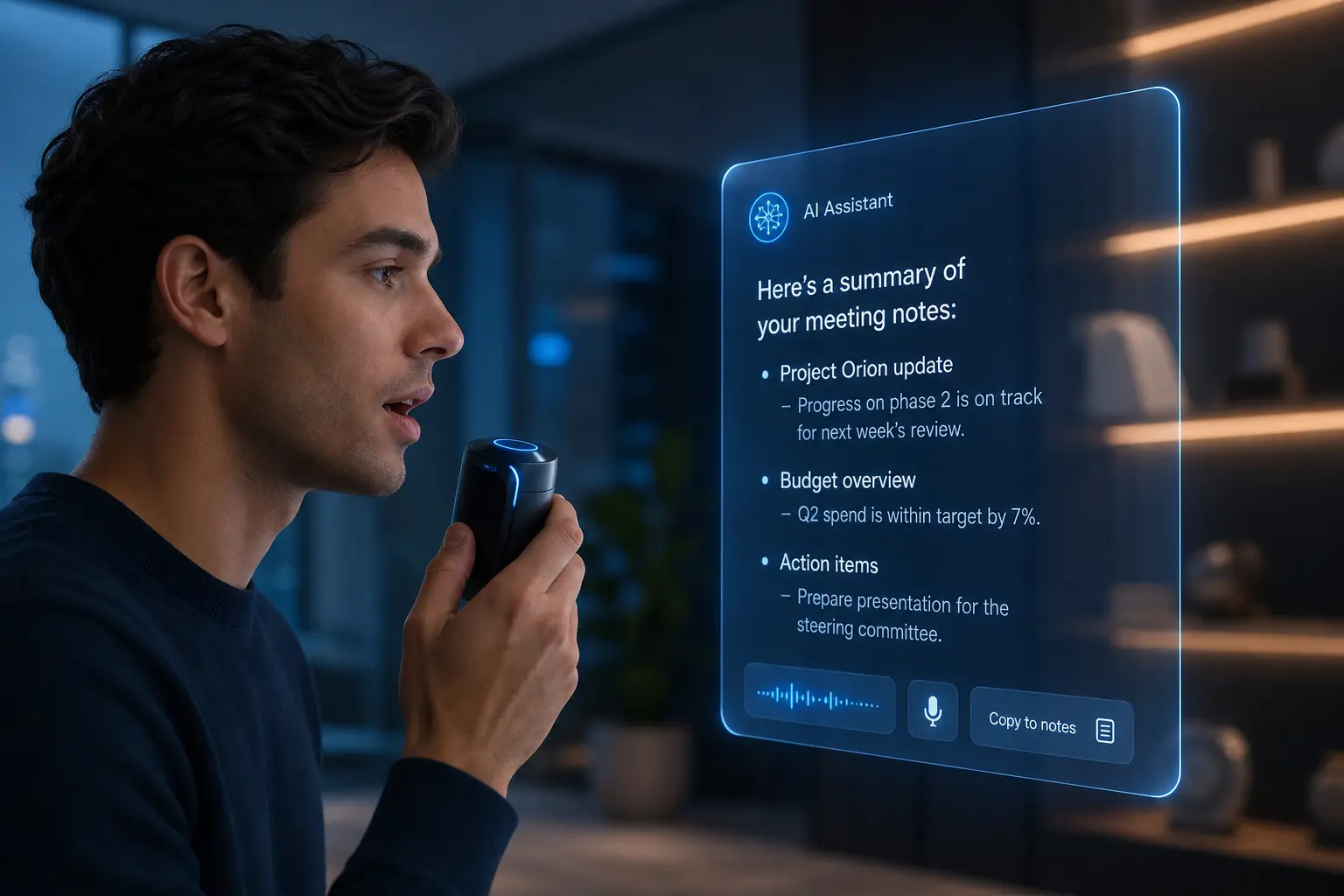
The core of this revolution lies in the synergy between large language models and advanced speech-to-text technologies. Early dictation systems struggled with nuances of human speech, accents, and contextual understanding. Today, LLMs enable these applications to:
- Decipher Speech with High Accuracy: They can better understand diverse accents, speech patterns, and even distinguish between multiple speakers.
- Retain Context and Format Text: Beyond mere transcription, AI can now infer meaning, apply correct punctuation, and format text logically, significantly reducing post-transcription editing.
- Intelligent Editing Features: Many apps now automatically remove filler words, correct grammatical stumbles, and offer stylistic adjustments, producing polished text that requires minimal human intervention.
Industry Insight: The integration of transformer models and neural networks has been pivotal in enhancing the accuracy and contextual understanding of AI dictation. These models can process vast amounts of linguistic data, allowing them to predict and correct errors more effectively than previous generations of speech recognition software. [1]
Top AI Dictation Apps of 2025: A Comprehensive Review
With a burgeoning market of AI dictation solutions, choosing the right tool can be daunting. We've rigorously tested and ranked some of the best and most useful dictation apps available today, focusing on their unique features, pricing models, and overall user experience.
1. Wispr Flow: The Customizable Powerhouse
Wispr Flow stands out as a well-funded AI dictation app offering extensive customization. It allows users to add custom words and dictation instructions, making it ideal for specialized terminology. Its native applications span macOS, Windows, and iOS, with an Android version in development. Users can tailor transcription styles (formal, casual, very casual) for different contexts, and its integration with vibe-coding tools like Cursor enables automatic recognition of variables and file tags. The app offers a free tier (2,000 words/week on desktop, 1,000 words/month on iOS) and paid plans starting at $15/month for unlimited transcription.
2. Willow: Privacy-First and Predictive
Willow positions itself as a significant time-saver, particularly for those averse to typing. Beyond standard editing and formatting, it leverages LLMs to generate full passages from minimal dictated words. A key differentiator is its privacy-focused approach, storing all transcripts locally and offering an opt-out for model training. Custom vocabulary can be added to adapt to industry-specific jargon or local dialects. Willow provides a free desktop tier (2,000 words/month) and individual subscriptions starting at $15/month for unlimited dictation and personalized writing style retention.
3. Monologue: Offline Security and Tone Control
For users prioritizing privacy, Monologue allows direct download of its AI model to the device, ensuring all transcriptions remain off the cloud. It also offers tone customization based on the application in use. The free tier includes 1,000 words/month, with subscriptions at $10/month or $100/year. Monologue even provides a physical shortcut device, the Monokey, to its most active users.
4. Superwhisper: Versatile Transcription and API Access
Superwhisper excels as a dictation app that also handles audio and video file transcriptions. It allows users to select and download various AI models, including its own and Nvidia’s Parakeet models, offering different speeds and accuracy levels. Custom prompts can steer output, and both processed and unprocessed transcripts are viewable. A basic voice-to-text feature is free, with a 15-minute trial for Pro features. Paid tiers enable the use of personal AI API keys and unlimited cloud/local model connections, starting at $8.49/month.
5. VoiceTypr: Offline, Open-Source, and Lifetime Access
VoiceTypr adopts an offline-first, no-subscription model, utilizing local models for transcription. Its open-source nature is supported by a GitHub repository, allowing self-hosting. It boasts support for over 99 languages and compatibility with Mac and Windows. After a three-day free trial, lifetime licenses are available, priced at $35 for one device, $56 for two, and $98 for four.
6. Aqua: Low Latency and Autofill Capabilities
Backed by Y Combinator, Aqua is a voice-typing app for Windows and macOS renowned for its exceptionally low latency, ensuring near-instant text appearance. It handles grammar and punctuation and features an autofill function for common phrases. Aqua also offers its own speech-to-text API for integration into other applications. The free tier provides 1,000 words/month, with paid plans starting at $8/month (billed annually) for unlimited words and expanded custom dictionary values.
7. Handy: Free, Open-Source, and Basic
Handy is an open-source, free transcription tool compatible with Mac, Windows, and Linux. While basic in features and customization, it serves as an excellent entry point for users seeking to integrate voice into their workflow without cost. It includes a simple settings menu for push-to-talk toggling and hotkey customization.
8. Typeless: High Free Word Count and Privacy Focused
Typeless distinguishes itself with a generous free word count and a strong commitment to privacy, claiming no data retention or use for AI model training. It also offers to rewrite fumbled sentences. The free tier allows up to 4,000 words/week (approximately 16,000 words/month). A paid plan at $12/month (billed annually) unlocks unlimited words and new features, available for Windows and macOS.
9. VoiceInk: Private, Context-Aware, and Assistant Mode
VoiceInk is an open-source private dictation app for Mac, supporting global shortcuts and a push-to-talk mode. It intelligently adjusts output based on screen context and can apply custom formatting rules for specific apps or URLs. An integrated assistant mode can answer user questions. Lifetime access is priced at $25 for one device, $39 for two, and $49 for three.
10. Dictato: Offline Models and Ultra-Low Latency
Dictato, a Mac dictionary app priced at €9.99 (around $12) for lifetime access and two years of updates, leverages offline models like Parakeet, Whisper, and Apple Speech Analyzer. It uses Apple Intelligence for light reading and filler word removal, boasting an impressive 80ms latency for almost instantaneous text generation.
11. AudioPen: Evolving Voice Notes and Rewriting Capabilities
Initially a web-based voice notes app, AudioPen has evolved into a comprehensive Mac version that allows users to dictate, store, and rewrite text in various formats and styles. It supports live transcription, cross-platform audio note storage, summary generation from combined notes, and AI-powered rewriting of existing notes. Pricing includes $33 for three months, $99 for a year, and $159 for two years.
Practical Explanation: The choice of an AI dictation app often comes down to a balance between features, privacy concerns, and pricing. Users who prioritize data security might opt for offline models, while those needing advanced integrations might prefer apps with API access. The variety in the market ensures that there's a solution for nearly every need. [2]
Conclusion: The Future is Spoken
AI dictation apps have transcended their early limitations, becoming indispensable tools for enhancing productivity and streamlining workflows. The advancements in LLMs and speech-to-text technology have paved the way for highly accurate, context-aware, and feature-rich applications. As these technologies continue to evolve, we can anticipate even more sophisticated features, further blurring the lines between spoken and written communication. The future of text creation is increasingly spoken, and these AI dictation apps are leading the charge.
References
[1] "The Role of Transformer Models in Speech Recognition" - AI Journal of Natural Language Processing
[2] "Choosing the Right Dictation Software: A User's Guide" - Productivity Tech Review