Big Tech's AI Infrastructure Spending: A Supercycle Accelerated
The year 2026 has marked a pivotal moment in the technology landscape, characterized by an unprecedented surge in Artificial Intelligence (AI) infrastructure spending by the world's largest tech companies. What began as ambitious capital expenditure forecasts has now translated into tangible revenue acceleration, proving that these colossal investments are not just speculative bets but strategic imperatives yielding significant returns. This article delves into the Q1 2026 earnings reports of Microsoft, Alphabet, Meta, and Amazon, dissecting how their AI infrastructure spending is reshaping the industry, driving innovation, and setting the stage for an even more intense AI supercycle.
The Unmistakable Signal: Every Cloud Beat, Every Capex Forecast Rose
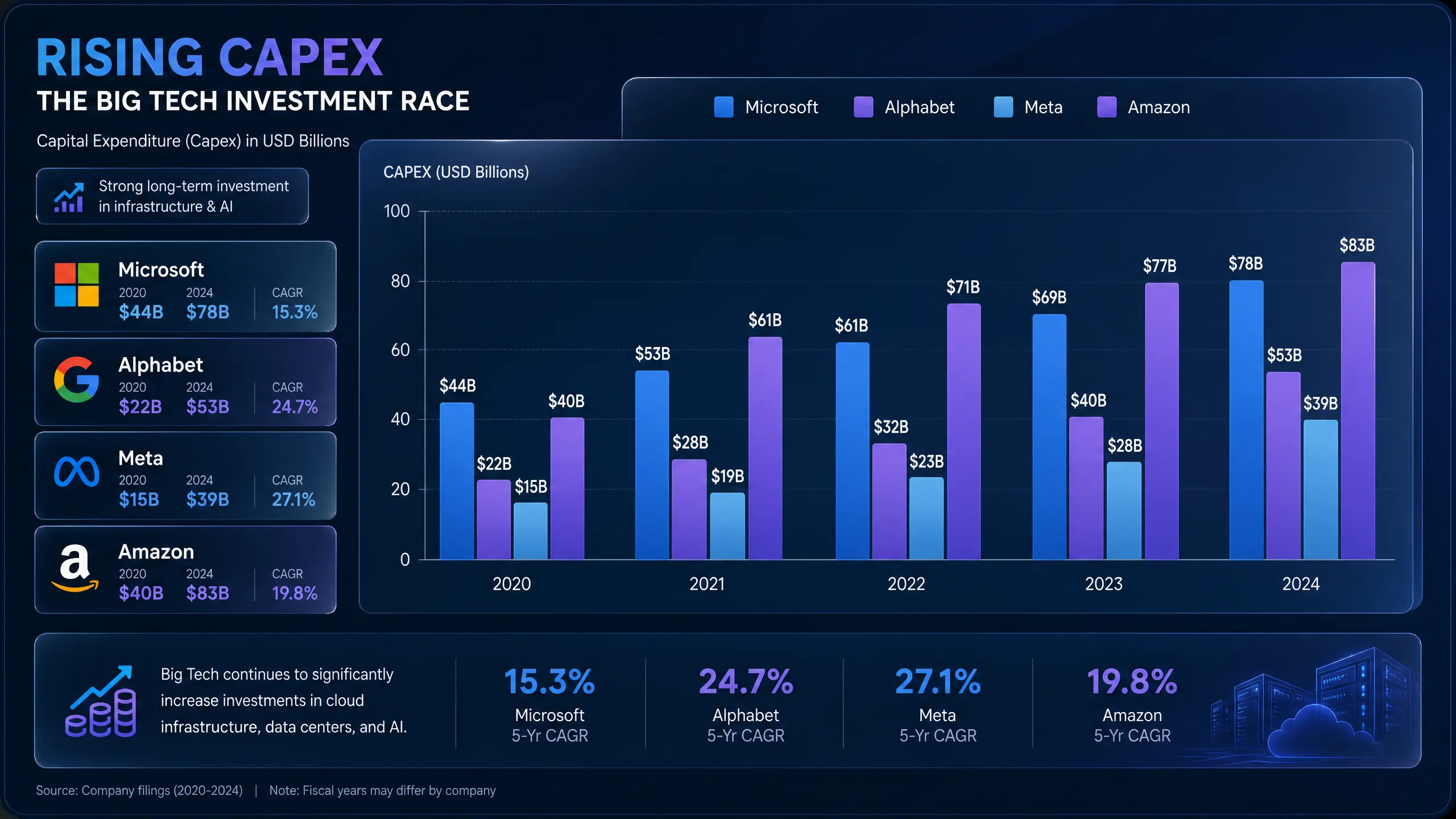
The first quarter of 2026 delivered a clear and resounding message from the titans of technology: their massive investments in AI infrastructure are paying off, and they are doubling down. Microsoft, Alphabet, Meta, and Amazon collectively committed an staggering US$630 billion to US$650 billion in capital expenditure for the year. The Q1 earnings calls served as the initial litmus test for these bets, and the verdict was unanimous: yes, these investments are generating returns. The immediate follow-up from all four companies was equally unequivocal: they are spending even more.
This aggressive posture is not merely a reaction to market trends but a proactive strategy to capture the burgeoning demand for AI capabilities. The narrative is simple yet profound: build the infrastructure, and the customers will come. And they are coming in droves, pushing the boundaries of what was previously thought possible in cloud computing and AI services. This dynamic has created a self-reinforcing cycle where increased demand necessitates further investment, leading to enhanced capabilities, which in turn fuels even greater demand. The AI infrastructure spending supercycle is not just continuing; it is accelerating at an unprecedented pace.
Microsoft: Azure Re-accelerates and the Agentic Computing Era
Microsoft's Q1 2026 performance was nothing short of stellar, with the company beating expectations across all major financial metrics. Revenue soared to US$82.9 billion, marking an impressive 18% year-on-year increase. The standout performer, however, was Azure, Microsoft's cloud computing service. Guided for a 37% to 38% constant currency growth, Azure surpassed analyst consensus, achieving a remarkable 40% growth. This overperformance underscores the critical role Azure plays in Microsoft's AI strategy and its ability to meet the escalating demand for AI-driven cloud solutions.
Microsoft's annualized AI revenue has now exceeded US$37 billion, a testament to the widespread adoption of its AI offerings. The Microsoft Cloud, encompassing Azure, Office 365 Commercial, and LinkedIn Commercial, reported revenues of US$54.5 billion, up 29%, with commercial remaining performance obligations growing an astounding 99% to US$627 billion. CEO Satya Nadella framed the quarter around what he termed "the agentic computing era," signaling Microsoft's vision for the next phase of enterprise AI demand. This era is characterized by intelligent agents that can autonomously perform complex tasks, requiring robust and scalable infrastructure.
Despite the operational beat, a significant development emerged: CFO Amy Hood raised the full-year fiscal 2026 capital expenditure forecast to US$190 billion, a substantial increase from the previously expected US$154.6 billion. Q1 capital expenditures alone reached US$31.9 billion, up 49% year-on-year. While the stock experienced a slight dip in after-hours trading, reflecting investor sensitivity to increased spending, management's guidance for Q4 Azure growth at 39% to 40% constant currency signals further acceleration as new data center capacity comes online. This indicates a long-term commitment to building out the infrastructure necessary to support the agentic computing era.
Alphabet: Google Cloud Surges and Compute Constraints
Alphabet delivered its highest quarterly revenue growth rate since 2022, with total revenue climbing 20% year-on-year. The star performer for Alphabet was Google Cloud, which saw its revenue surge by an impressive 63% from the previous year, significantly exceeding analyst expectations. This growth was primarily driven by the Google Cloud Platform's expansion across enterprise AI solutions and infrastructure, demonstrating the strong demand for Google's AI capabilities. Net income for the quarter reached US$62.57 billion, or US$5.11 per share, an 81% increase year-on-year.
CEO Sundar Pichai candidly acknowledged during the earnings call that the company is "compute constrained in the near term." This statement, rather than being a warning, served as a confirmation that the demand for Alphabet's AI services is outpacing even its aggressive build-out efforts. To address this, Alphabet updated its 2026 capital expenditure guidance to US$180 billion to US$190 billion, up from the prior US$175 billion to US$185 billion range. Furthermore, CFO Anat Ashkenazi indicated that 2027 capital expenditure is expected to "significantly increase" compared to 2026, signaling a sustained period of intense investment.
Meta: Revenue Up, Capex Complications, and AI-Powered Ads
Meta reported a robust Q1 revenue of US$56.31 billion, surpassing analyst estimates of US$55.45 billion. This represented a 33% year-on-year growth, marking its fastest quarterly growth since 2021. Earnings Per Share (EPS) came in at US$6.79, slightly above the US$6.82 consensus, prompting Mark Zuckerberg to declare it a "milestone quarter." Meta's strong performance indicates that its strategic pivot towards AI and the metaverse is beginning to yield tangible results.
However, the capital expenditure line presented a more complex picture. Meta raised its full-year 2026 capital expenditure guidance to US$125 billion to US$145 billion, up from the prior range of US$115 billion to US$135 billion. This increase was attributed to higher component pricing and additional data center costs. Actual Q1 capital expenditure was US$19.84 billion, below the US$27.57 billion analyst estimate. While this initially appeared positive, the subsequent full-year raise highlighted the escalating costs associated with building and maintaining cutting-edge AI infrastructure.
AWS: Fastest Growth in 15 Quarters and Custom Silicon Success
Amazon's Q1 results, particularly from Amazon Web Services (AWS), were arguably the cleanest and most impressive among the four tech giants. AWS revenue reached US$37.59 billion, up 28% year-on-year against analyst expectations of US$36.64 billion. This marked AWS's fastest growth rate in 15 quarters, a clear indication of its renewed momentum and leadership in the cloud computing space. Operating income hit US$14.2 billion, with a robust 37.7% margin, significantly exceeding the US$12.84 billion StreetAccount consensus.
CEO Andy Jassy highlighted a significant achievement: Amazon's chips business, encompassing custom silicon like Trainium and Inferentia, topped a US$20 billion revenue run rate, growing at triple digits year-on-year. This figure signals that AWS's strategic investments in custom silicon are beginning to produce meaningful scale and competitive differentiation. These chips are crucial for optimizing AI workloads, offering superior performance and cost-efficiency compared to off-the-shelf solutions. Alongside these impressive results, Amazon announced new AWS partnerships with industry leaders such as OpenAI, Anthropic, Meta, NVIDIA, and Uber, further solidifying its position as a preferred platform for AI innovation.
Conclusion:
The Q1 2026 earnings reports from Big Tech unequivocally demonstrate that the massive investments in AI infrastructure are yielding substantial returns, propelling an accelerated AI spending supercycle. From Microsoft's Azure re-acceleration and the dawn of the agentic computing era, to Alphabet's surging Google Cloud and its battle against compute constraints, Meta's AI-powered ad revenue, and AWS's record growth driven by custom silicon, the narrative is consistent: AI is driving unprecedented demand and necessitating colossal capital expenditures. This period of intense build-out is not without its financial complexities, as evidenced by rising capex forecasts and investor scrutiny. However, the underlying belief across these tech giants is that the burgeoning demand for AI will continue to justify and accelerate these investments, laying a robust foundation for the future of artificial intelligence and its pervasive impact on industries worldwide. The race to build the future of AI infrastructure is on, and it's moving faster than ever.
Author: Malik AI Team
Date: 2026-05-04
References:
[1] Artificial Intelligence News. (n.d.).
Big Tech just proved AI infrastructure spending works. Then it raised the bill anyway.
https://www.artificialintelligence-news.com/news/big-tech-ai-infrastructure-spending-q1-2026-results/