- Malik Logix
- Posts
- NVIDIA Google Infrastructure Cuts AI Inference Costs
NVIDIA Google Infrastructure Cuts AI Inference Costs
Explore how NVIDIA and Google are collaborating to significantly reduce AI inference costs and enhance performance with new hardware and software innovations.

Malik Farooq
May 6, 2026
Deep Dive
Introduction: The Escalating Challenge of AI Inference Costs
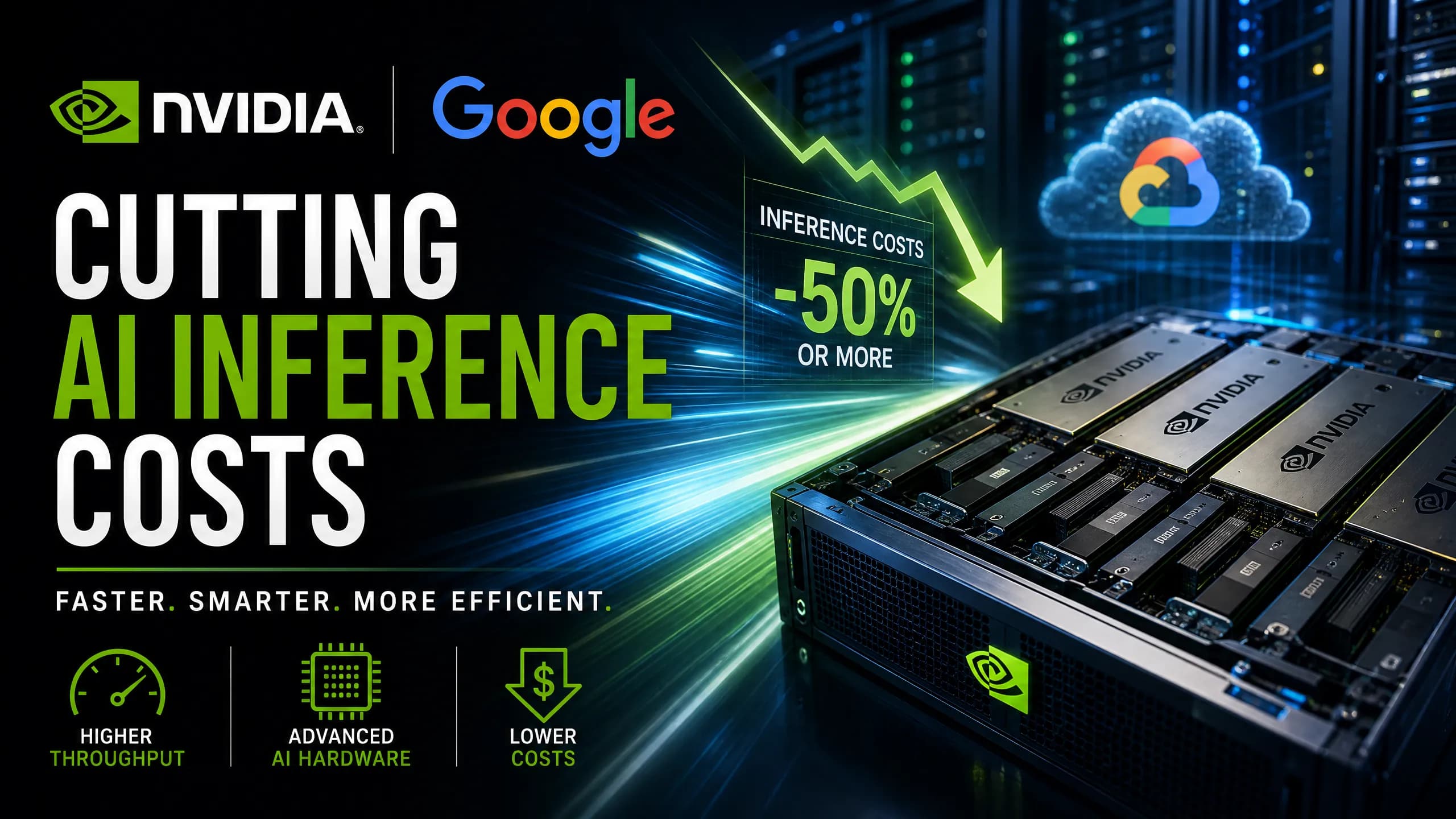
As artificial intelligence models grow in complexity and deployment scale, the cost of AI inference—the process of running a trained AI model to make predictions or decisions—has become a critical concern for enterprises. High inference costs can hinder the widespread adoption of advanced AI applications, limiting their economic viability. In response to this challenge, NVIDIA and Google have unveiled a strategic collaboration, detailing a hardware and software roadmap designed to drastically reduce AI inference expenses and boost performance at scale.
A New Era of Efficiency: A5X Bare-Metal Instances
At the recent Google Cloud Next conference, both technology giants showcased their joint efforts, highlighting the introduction of new A5X bare-metal instances. These instances are powered by NVIDIA Vera Rubin NVL72 rack-scale systems, representing a significant leap forward in AI infrastructure. The innovative co-design of hardware and software in these systems is engineered to deliver unparalleled efficiency.
Unprecedented Cost Reduction and Throughput
The A5X architecture aims to achieve up to ten times lower inference cost per token compared to previous generations. Simultaneously, it promises ten times higher token throughput per megawatt, signifying a massive improvement in both economic and environmental efficiency. This dual benefit is crucial for enterprises looking to deploy large-scale AI models without incurring prohibitive operational expenditures.
Real-world Example: Imagine a large language model processing millions of queries daily. A tenfold reduction in inference cost per token translates into substantial savings, making advanced AI applications accessible to a broader range of businesses. The increased throughput also means faster response times and the ability to handle more concurrent users, enhancing user experience and operational capacity.
Bridging the Gap: High-Bandwidth Interconnects
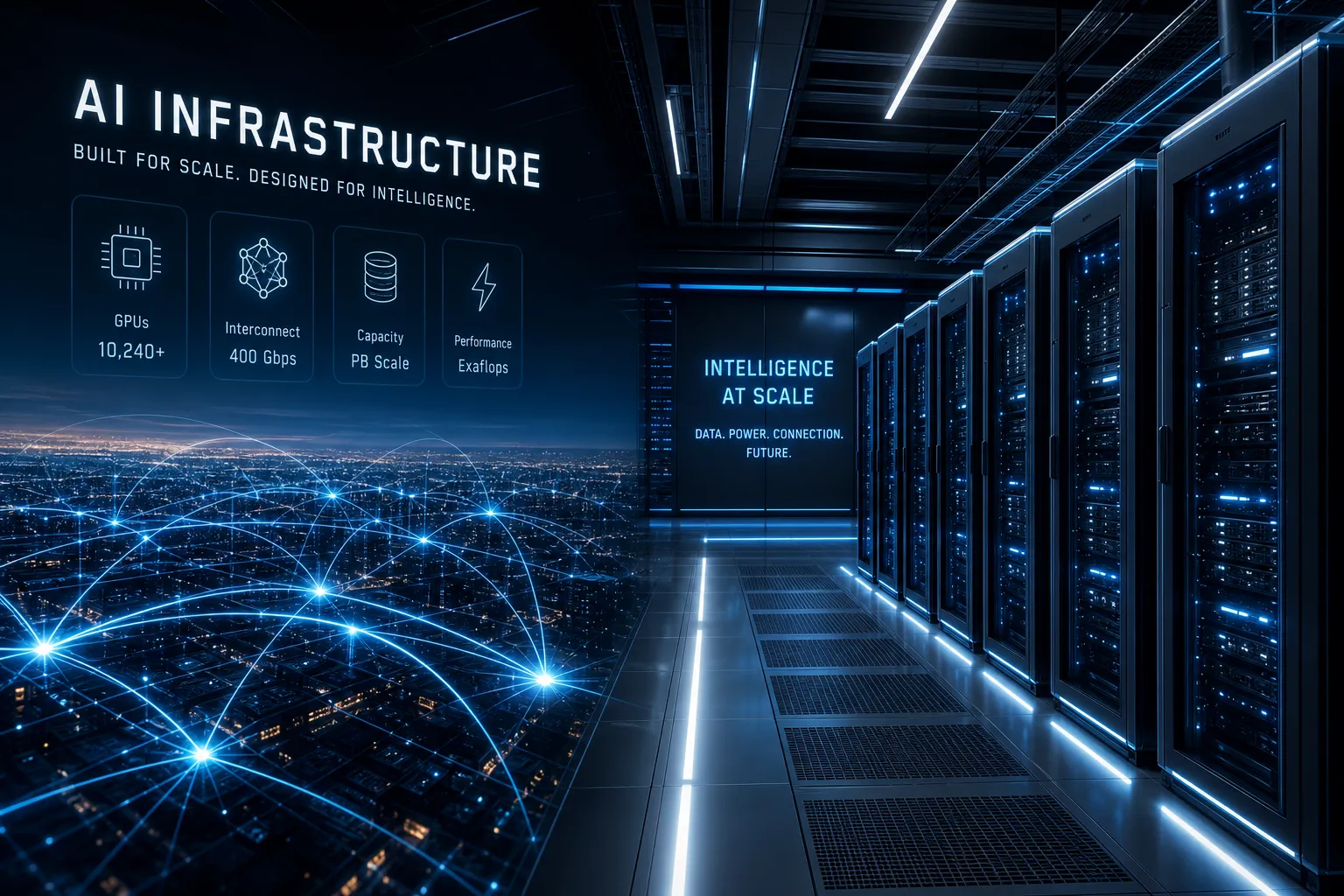
Scaling AI inference to thousands of processors demands immense bandwidth to prevent processing delays and ensure seamless data flow. The A5X instances tackle this challenge by integrating NVIDIA ConnectX-9 SuperNICs with Google Virgo networking technology. This powerful combination creates a robust and high-speed interconnect fabric essential for large-scale AI deployments.
Massive Scalability for AI Workloads
This configuration supports an astounding scale, capable of accommodating up to 80,000 NVIDIA Rubin GPUs within a single site cluster and extending to 960,000 GPUs across a multisite deployment. Managing workloads at this magnitude requires sophisticated orchestration to ensure exact synchronization and prevent idle compute time, a critical factor in maintaining cost-effectiveness.
Mark Lohmeyer, VP and GM of AI and Computing Infrastructure at Google Cloud, emphasized the strategic vision: "At Google Cloud, we believe the next decade of AI will be shaped by customers’ ability to run their most demanding workloads on a truly integrated, AI‑optimised infrastructure stack."
Sovereign Data Governance and Cloud Security
Beyond raw processing power, data governance and cloud security remain paramount, especially for highly regulated industries like finance and healthcare. These sectors often face stringent data sovereignty requirements and concerns about exposing proprietary information, which can impede machine learning initiatives. NVIDIA and Google are addressing these challenges with advanced security features.
Confidential Computing for Enhanced Data Protection
Google Gemini models, running on NVIDIA Blackwell and Blackwell Ultra GPUs, are now available in preview on Google Distributed Cloud. This deployment model allows organizations to maintain frontier models within their controlled environments, safeguarding sensitive data stores. A cornerstone of this security framework is NVIDIA Confidential Computing, a hardware-level protocol that encrypts training models, prompts, and fine-tuning data, preventing unauthorized access even by cloud infrastructure operators.
For multi-tenant public cloud environments, Confidential G4 VMs, equipped with NVIDIA RTX PRO 6000 Blackwell GPUs, offer similar cryptographic protections. This innovation provides regulated industries with access to high-performance hardware without compromising data privacy standards, marking a significant milestone as the first cloud-based confidential computing offering for NVIDIA Blackwell GPUs.
Streamlining Agentic AI Training
Developing multi-step agentic AI systems involves complex integrations, continuous vector database synchronization, and mitigating algorithmic hallucinations. NVIDIA and Google are simplifying these engineering demands to accelerate the development and deployment of sophisticated AI agents.
NVIDIA Nemotron 3 Super and Managed Training Clusters
NVIDIA Nemotron 3 Super is now integrated into the Gemini Enterprise Agent Platform, offering developers tools to customize and deploy reasoning and multimodal models tailored for agentic tasks. The broader NVIDIA platform on Google Cloud supports various models, including Google’s Gemini and Gemma families, enabling developers to build systems that can reason, plan, and act effectively.
Training these models at scale often leads to substantial operational overhead, particularly in managing cluster sizing and hardware failures during prolonged reinforcement learning cycles. To counter this, Google Cloud and NVIDIA have introduced Managed Training Clusters on the Gemini Enterprise Agent Platform, featuring a managed reinforcement learning API built with NVIDIA NeMo RL. This system automates cluster sizing, failure recovery, and job execution, allowing data science teams to focus on model quality rather than infrastructure management.
Industry Insight: CrowdStrike, for instance, leverages NVIDIA NeMo open libraries to generate synthetic data and fine-tune models for cybersecurity applications. Operating these models on Managed Training Clusters with Blackwell GPUs significantly accelerates their automated threat detection and response capabilities, demonstrating the real-world impact of these advancements.
Legacy Architecture Integration and Physical Simulations
Integrating machine learning into heavy industry and manufacturing presents unique engineering challenges, including connecting digital models to physical factory floors, requiring precise physical simulations, massive compute power, and standardization across diverse legacy data formats. NVIDIA’s AI infrastructure and physical AI libraries on Google Cloud provide a robust foundation for simulating and automating real-world manufacturing workflows.
Major industrial software providers like Cadence and Siemens are making their solutions available on Google Cloud, accelerated by NVIDIA infrastructure. These tools are vital for the engineering and manufacturing of heavy machinery, aerospace platforms, and autonomous vehicles. By utilizing NVIDIA Omniverse libraries and the open-source NVIDIA Isaac Sim framework via the Google Cloud Marketplace, developers can create physically accurate digital twins and train robotics simulation pipelines, bypassing traditional data translation issues.
Deploying NVIDIA NIM microservices, such as the Cosmos Reason 2 model, to Google Vertex AI and Google Kubernetes Engine, further enables vision-based agents and robots to interpret and navigate their physical surroundings. This integration facilitates a seamless transition from computer-aided design to living industrial digital twins.
Impact Across the Accelerated Compute Ecosystem
The collaboration between NVIDIA and Google is already yielding quantifiable financial returns and accelerating innovation across various sectors. The broad portfolio of solutions, ranging from full NVL72 racks to fractional G4 VMs, allows customers to precisely provision acceleration capabilities for diverse tasks, including mixture-of-experts reasoning and data processing.
Statistics/Data Points:
- Thinking Machines Lab: Scales its Tinker API on A4X Max VMs to accelerate training.
- OpenAI: Utilizes large-scale inference on NVIDIA GB300 and GB200 NVL72 systems on Google Cloud for demanding workloads like ChatGPT operations.
- Snap: Transitioned data pipelines to GPU-accelerated Spark on Google Cloud, significantly cutting costs associated with large-scale A/B testing.
- Schrödinger: Leverages NVIDIA accelerated computing on Google Cloud to compress drug discovery simulations from weeks to hours.
The joint NVIDIA and Google Cloud developer community has rapidly expanded, with over 90,000 developers joining within a year. Startups like CodeRabbit and Factory are applying NVIDIA Nemotron-based models on Google Cloud for code reviews and autonomous software development agents. Companies such as Aible, Mantis AI, Photoroom, and Baseten are building enterprise data, video intelligence, and generative imagery solutions using this full-stack platform.
Conclusion: A Future of Cost-Effective and Scalable AI
The partnership between NVIDIA and Google Cloud is forging a future where AI is not only powerful but also cost-effective and scalable. By addressing critical challenges in inference costs, data governance, agentic AI training, and industrial integration, they are enabling enterprises to unlock the full potential of AI. This collaboration is set to transform experimental agents and simulations into production-ready systems that secure fleets, optimize factories, and drive innovation across the physical and digital worlds.

References
[1] NVIDIA and Google infrastructure cuts AI inference costs. (2026, April 23). AI News. https://www.artificialintelligence-news.com/news/nvidia-and-google-infrastructure-cuts-ai-inference-costs/
Ready to master AI?
Join 1,000+ professionals getting the edge in AI marketing. 3 minutes a day to 10x your growth.
Join Free NowKeep reading
Agentic AI Governance Enterprise Readiness
Explore Google's innovative agentic AI governance platform and assess whether enterprises are truly prepared for the shift towards autonomous AI systems.
Malik Farooq/

AI Agents Interaction Infrastructure
Explore why AI agents require robust interaction infrastructure to prevent automation waste and ensure efficient, secure, and compliant operations in enterprise environments.
Malik Farooq/
AI Platform Bob: Revolutionizing SDLC Cost Regulation
Discover how IBM's AI platform Bob is transforming software development lifecycle (SDLC) governance and cost regulation for enterprises.
Malik Farooq/
Back to archive
Share